
LoRaWAN as the basis for a versatile IoT infrastructure
The LPWAN technology for energy-efficient, secure, and scalable IoT infrastructures
What is LoRaWAN ?
LoRaWAN (Long Range Wide Area Network) is a standardized radio protocol for Low Power Wide Area Networks (LPWAN). It was developed to enable energy-efficient IoT communication over long distances while supporting battery lifetimes of several years.
The technology is particularly suitable for applications where small amounts of data need to be transmitted over wide areas.
LoRaWAN operates in the license-free sub-GHz frequency band (e.g., 868 MHz in Europe) and can achieve ranges of several kilometers.
Thanks to its high scalability, energy efficiency, and global adoption, LoRaWAN is considered one of the most important LPWAN technologies in the IoT sector. It provides a cost-effective, reliable, and future-proof solution for connecting a wide range of IoT devices.
What is the LoRaWAN Alliance?
The LoRa Alliance is an international industry association that develops, maintains, and promotes the LoRaWAN standard worldwide. Its goal is to provide an open, interoperable, and vendor-independent communication platform for IoT applications.
The organization defines the technical specifications of the standard and continuously evolves them. A key focus is ensuring interoperability between devices from different manufacturers.
Through certification programs, the LoRa Alliance ensures that end devices, gateways, and network components comply with the official specifications.
In addition, the Alliance fosters a global ecosystem of technology providers, network operators, system integrators, and enterprise users. Through this standardization, LoRaWAN can be deployed worldwide and offers companies a stable, long-term, and future-proof IoT solution.
Today’s IoT challenges
The number of connected devices is continuously increasing — and so is the volume of transmitted data. Wireless networks are becoming more congested, interference is rising, and the demands for range and energy efficiency are growing.
Many IoT projects fail not because of the idea itself, but due to a missing or unsuitable communication infrastructure.
Additional requirements include secure data transmission, cost-efficient operation, and the ability to scale solutions across multiple locations. Without a powerful LPWAN technology, these goals are difficult to achieve.
LoRaWAN provides a robust foundation: long range, low energy consumption, and an architecture specifically designed for reliable and scalable IoT networks.
Physical and technological limitations of LoRaWAN
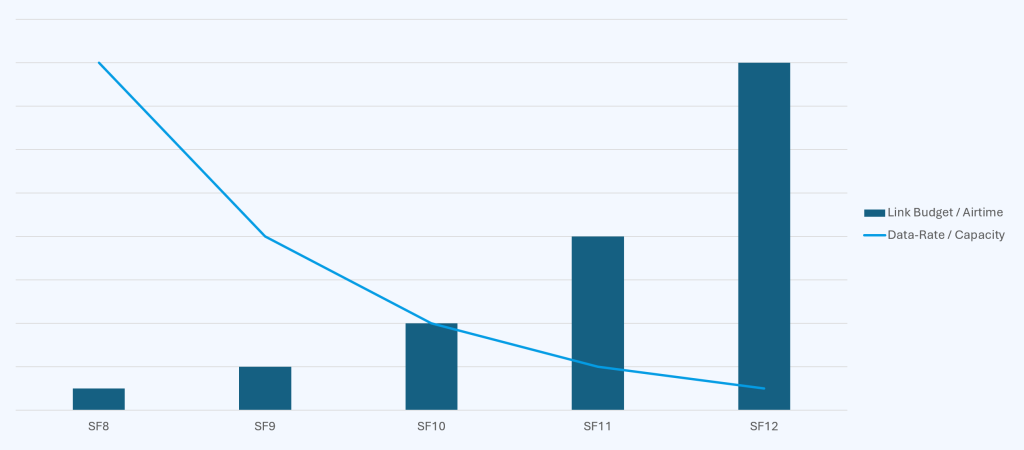
LoRaWAN, as an LPWAN technology, is optimized for energy-efficient point-to-point communication over long distances. Applications involving large data volumes, continuous transmission, or operation in highly congested networks can reach technical limits.
Regulatory restrictions in the license-free sub-GHz band and the energy-optimized design lead to higher latencies and limit the number of possible transmissions per device.
Limited payload rate: LoRaWAN is designed for small, sporadic data packets — continuous or very large data streams are not intended.
Regulatory duty cycle restrictions: Legal regulations limit the maximum transmission time per end device, thereby restricting transmission frequency.
Increased latency: The energy-efficient communication principle can lead to delays, especially with confirmed messages or downlink communication.
Limited downlink capacity: The focus is on uplink data; return channels are only available to a limited extent and are not intended for continuous communication.
- Network congestion at high device density: In scenarios with a very large number of end devices, collisions, retransmissions, and thus reduced overall efficiency may occur.
The LoRaWAN technology
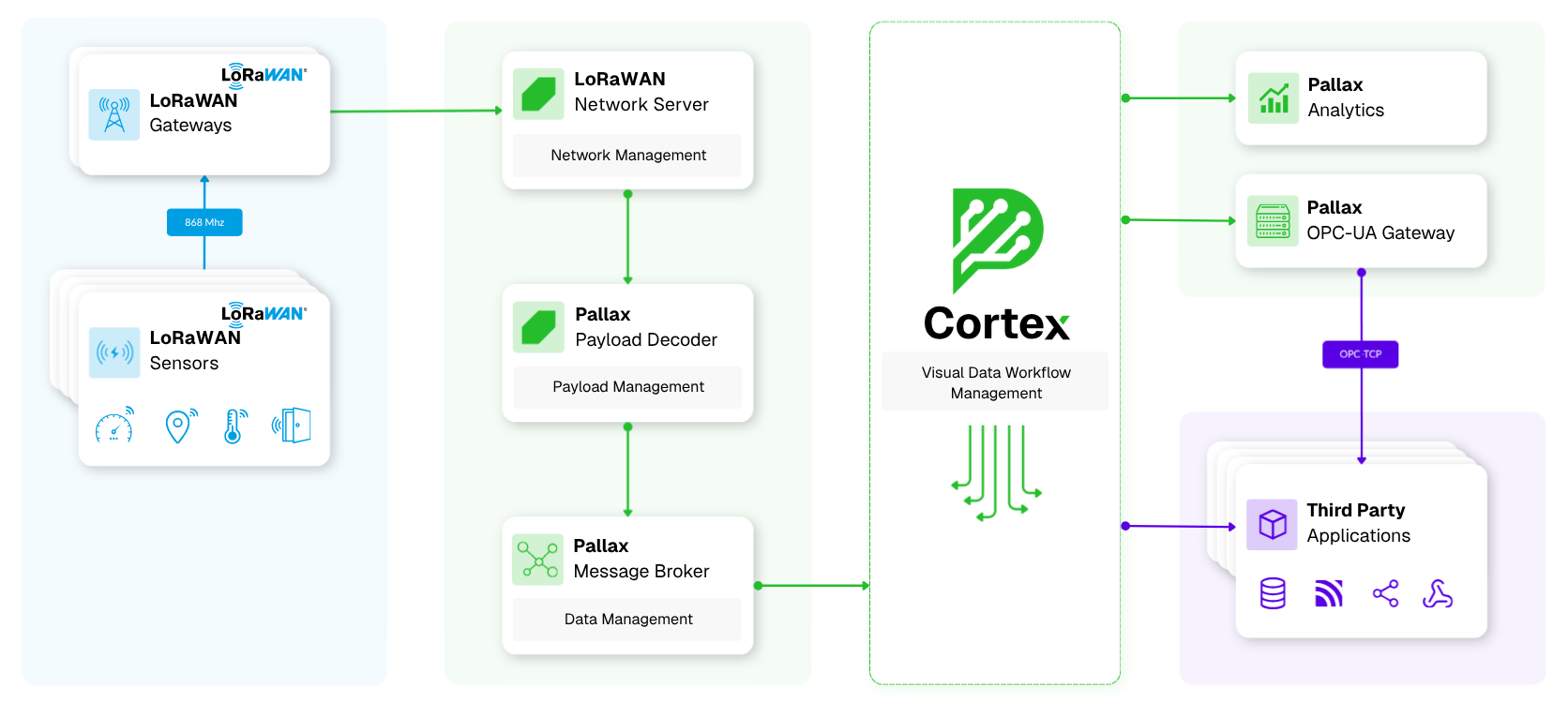
LoRaWAN is based on LoRa modulation, which uses the Chirp Spread Spectrum (CSS) method to enable robust and energy-efficient radio transmission over long distances — up to several kilometers in urban areas and up to 15 km in rural environments. The network architecture follows a so-called “star-of-stars” topology.
End devices do not communicate directly with each other; instead, they transmit their data via radio to one or more gateways. These gateways act as transparent relay stations and forward the received data packets via an IP-based connection to a central network server.
The network server then performs key functions such as end-device authentication, message routing, security management, and network management. The actual application servers access the data provided by the network server through defined interfaces in order to process, analyze, or integrate it into other systems.
Pallax Data and IoT Platform & LoRaWAN Technology
Innovative No-Code Interface in Pallax
Pallax is designed from the ground up as a LoRa-native platform and provides full, end-to-end support for the LoRa standard.
From connecting gateways and sensors from various manufacturers to device management and secure data processing, LoRaWAN is fully integrated into the platform. This enables the entire LoRaWAN infrastructure to be deployed within minutes — without external systems or downstream isolated solutions.
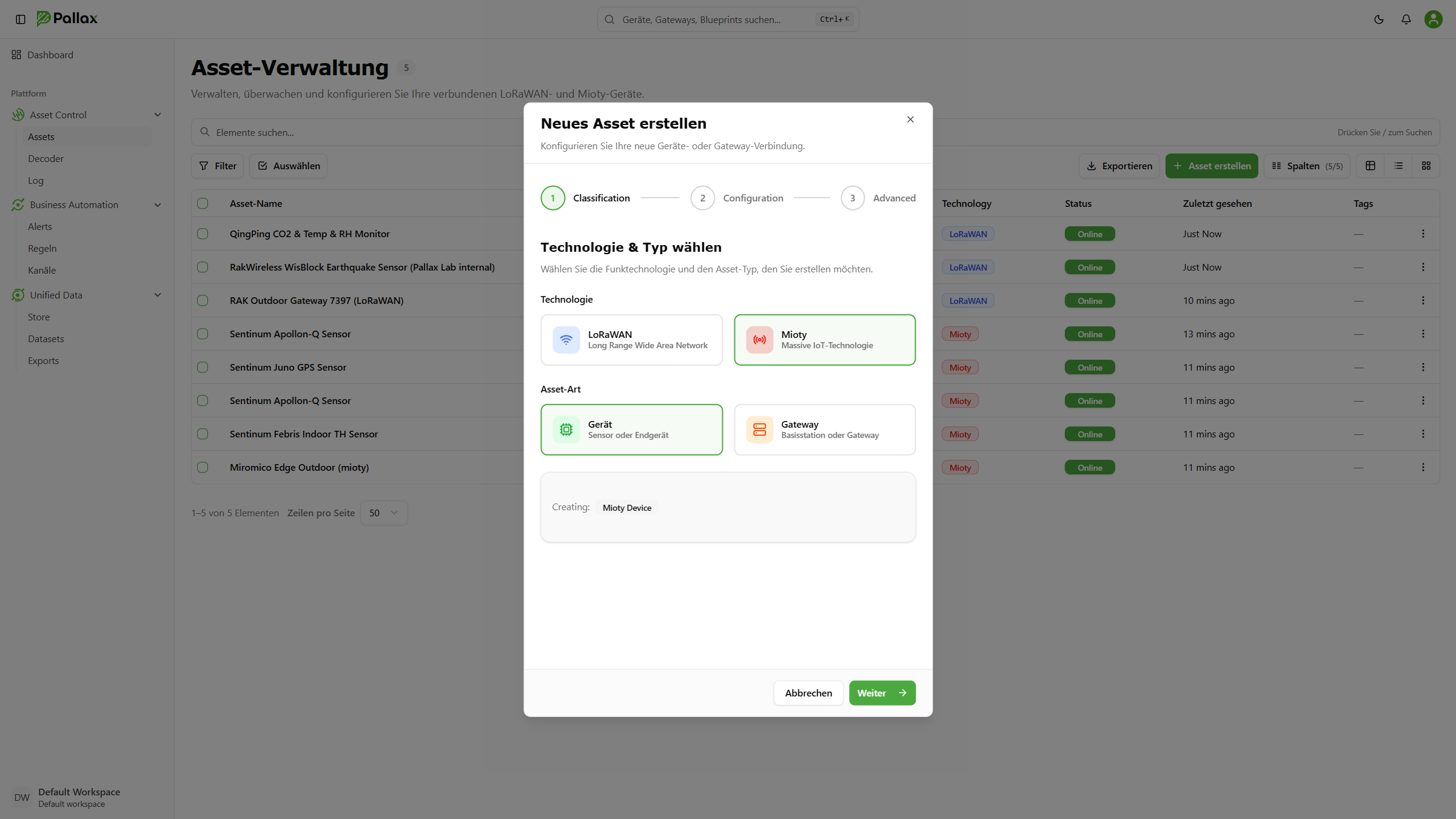
The intuitive no-code interface of Pallax enables even users without in-depth technical expertise to easily plan, build, and centrally manage complete IoT infrastructures — scalable, secure, and fully from a single source.
Companies benefit from a stable and future-proof IoT foundation designed for small and medium-sized projects as well as large, complex, and long-term IoT scenarios. Getting started requires no high upfront investment and no extensive or weeks-long training.
Pallax makes professional IoT projects easily accessible — from the initial idea to scalable operation.
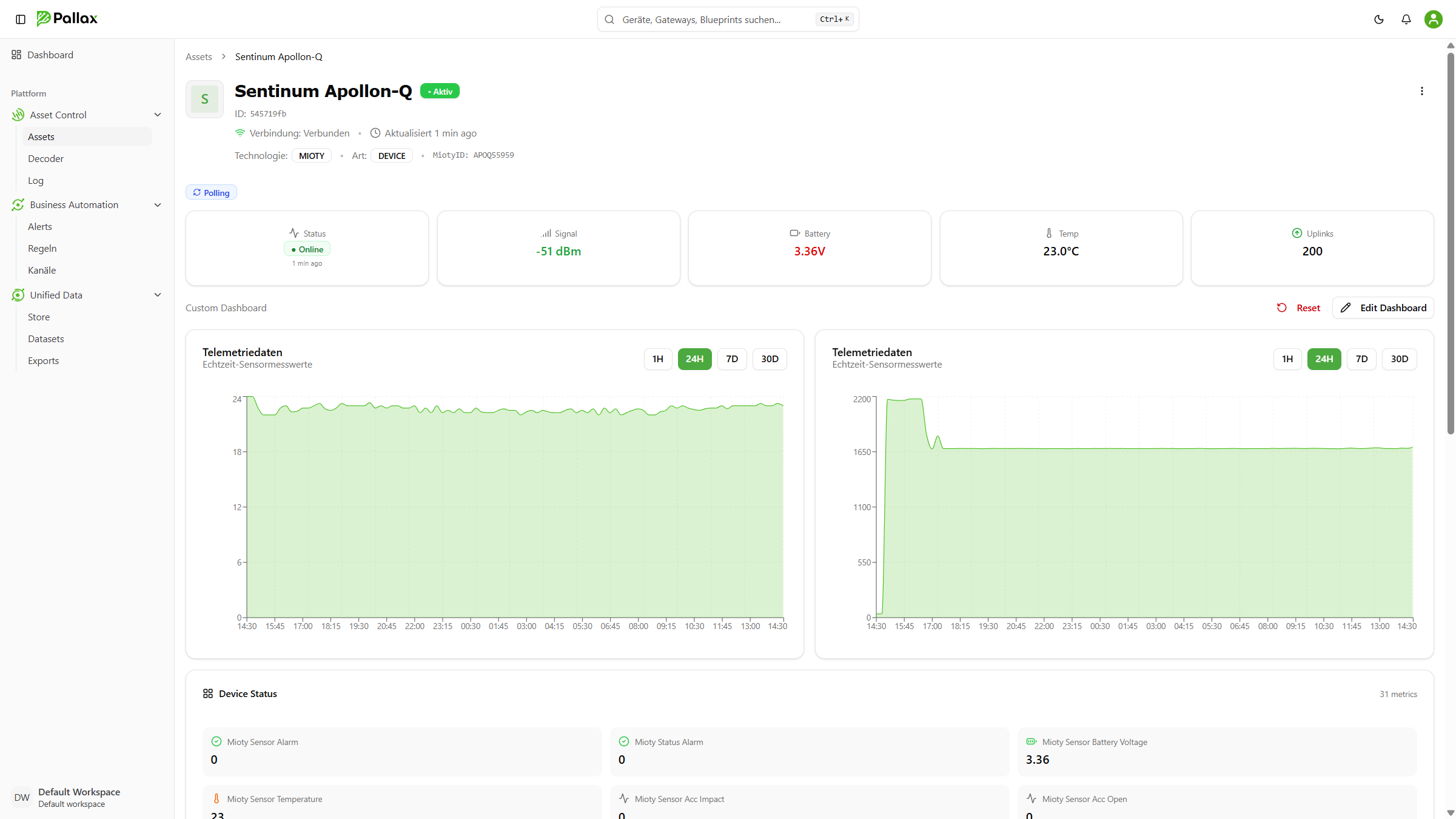
Custom Dashboards with Configurable Widgets in Pallax
Individually configurable widgets enable the creation of dashboards precisely tailored to each specific use case.
The collected data can be flexibly processed, enriched, and automated — including the use of integrated AI features such as anomaly detection. In this way, raw data is transformed into contextualized, meaningful information that supports well-informed real-time decision-making.
At the same time, all data remains fully within the Pallax platform and under the company’s complete control — secure, traceable, and independent of external systems or cloud services.
Consulting, Operations and Service with Pallax
The abl solutions GmbH supports IoT projects holistically upon request — going far beyond the platform itself.
From consulting on the selection of suitable LoRaWAN sensors and gateways, to the planning and deployment of the radio environment, all the way through to full commissioning.
This is complemented by comprehensive IoT services such as monitoring, operations, maintenance, security concepts, and integration into existing IT and business processes.
The result is a seamless end-to-end solution — from the physical world to actionable information.
Try Pallax for free. No credit card or software installation required
The LoRaWAN® logo is a registered trademark. All rights are held by the LoRa Alliance. Images and graphics relating to LoRaWAN are protected by copyright and are the property of the LoRa Alliance.